Sunday, May 17, 2026

DIY 80m Magnetic Loop Antenna: A Compact Solution for Low Bands

For many amateur radio operators, the 80-meter band is a “holy grail” of nighttime DX and local ragchewing. However, a full-size dipole for 80m requires nearly 40 meters of space—a luxury many urban hams don’t have. Enter the 80m Magnetic Loop Antenna (MLA).

Based on the design by Nitin William VU3GAO, this 1.5-meter diameter loop allows you to operate on the 3.5 MHz band with a footprint smaller than a garden table.

Magnetic Loop Antenna

DIY 80m Magnetic Loop Antenna: A Compact Solution for Low Bands

Friday, May 15, 2026

RW4HFN Balcony Antenna for the 20-Meter Band

For amateur radio operators working with limited space, especially in urban settings, the RW4HFN balcony antenna offers a clever and compact solution for operating on the 20-meter band. This design is particularly suited for installation on balconies or small terraces, making it ideal for apartment dwellers or those with HOA restrictions.

Living in an apartment or having limited outdoor space doesn’t mean you have to give up on HF operations. This Balcony antenna offers several compelling advantages for the space-challenged ham operator. Its lightweight fiberglass construction makes it easy to deploy and take down, perfect for temporary installations or portable operations. The antenna can be mounted on a balcony, deployed in a park, or set up during field day events with minimal effort.

What makes this design particularly attractive is its simplicity. Unlike more complex antenna systems requiring extensive hardware and permanent mounting solutions, the fishing pole antenna uses readily available materials and can be assembled with basic tools. The wire elements are supported by an inexpensive telescoping fishing pole, which provides the necessary height and structural support without the weight and complexity of traditional antenna supports.

Balcony Antenna

RW4HFN Balcony Antenna for the 20-Meter Band

Thursday, May 14, 2026

Low-Loss Feedline on a Budget: Building 450 to 600 Ohm DIY Ladder Line from Common Materials

DIY Ladder Line for the HF Ham A complete technical guide to building, routing, and using open-wire balanced feedline at your station

Ladder line is a type of feedline made of two parallel wires held apart by small spacers at regular intervals. When you look at it from the side it looks exactly like a ladder — hence the name. The spacers keep the wires a fixed distance apart all the way from the antenna down to your radio room.

Unlike coax cable, which has a center conductor buried inside solid plastic and covered by a metal braid, ladder line is open to the air. This is not a flaw. It is actually its biggest strength. Air is one of the best insulators there is, and it does not eat up your signal the way solid plastic does.


The two wires carry equal and opposite signals. Because they are close together and balanced, the fields from each wire mostly cancel each other out. Very little energy radiates from the feedline itself. This means nearly all your transmitter power reaches the antenna, where it belongs.

Low-Loss Feedline on a Budget: Building 450 to 600 Ohm DIY Ladder Line from Common Materials

Simple High-Gain collinear antenna using coaxial cable

Among the many antenna designs available to amateur radio operators, the coaxial collinear antenna stands out for its rare combination of simplicity, low cost, and excellent performance. Built almost entirely from ordinary coaxial cable, this antenna is capable of producing real gain over a standard quarter-wave vertical while maintaining an omnidirectional radiation pattern that is ideal for local and regional VHF and UHF communication.

The antenna shown in the below attached diagram is a classic example of a vertically stacked coaxial collinear design. Variations of this antenna have been built and refined by radio amateurs around the world for decades, and many commercial base-station antennas use the same underlying principle, hidden inside fiberglass radomes. What makes this design especially attractive is that it requires no traps, coils, or complex matching networks. When built carefully, it works “right the first time” and delivers consistent results.

coaxial collinear antenna

Simple High-Gain collinear antenna using coaxial cable

3 x 5/8 Collinear antenna for 435 MHz UHF Band

For UHF repeater systems operating around 435 MHz, antenna efficiency and gain are critical. Simple vertical antennas often do not provide sufficient performance, especially when wide coverage and reliable signal strength are required. To address this need, a UHF collinear antenna design adapted from the well-known Diamond BC-200 has been developed and documented by Kostadin Evstatiev (LZ1DJ).This 3 x 5/8 Collinea antenna is intended specifically for the 420–440 MHz band and provides high gain without requiring post-installation tuning when constructed accurately.

3 x 5/8 Collinear antenna for 435 MHz UHF Band

3 x 5/8 Collinear antenna for 435 MHz UHF Band

Hourglass Loop Antenna : A Stealthy Performer for VHF and UHF

If you’re hunting for a high-performance antenna that doesn’t look like a metallic porcupine, the Hourglass Loop (popularized by K4ERO) is a fantastic weekend project. It is essentially two delta loops stacked and fed in-phase, resulting in a bidirectional pattern with about 5 dB of gain over a standard dipole.

Hourglass Loop Antenna

Unlike a typical 1-wavelength loop, the hourglass uses a 2-wavelength wire. The crossing point in the center acts as a phasing section, forcing currents in the top and bottom horizontal segments to be in phase. This creates a narrow vertical radiation pattern that puts your signal exactly where it needs to be: on the horizon.

Hourglass Loop Antenna : A Stealthy Performer for VHF and UHF

Wednesday, May 13, 2026

DIY 3-Element 433 MHz Yagi Antenna for Amateur Radio

Directional antennas can dramatically improve signal quality in the 433 MHz band. Whether you work with amateur radio, telemetry, LoRa projects, remote sensors, or experimental RF systems, a compact Yagi antenna is often one of the simplest upgrades you can make.

This particular 3-element 433 MHz Yagi Antenna design stands out because it combines good forward gain with straightforward construction. It uses a reflector, a loop-driven element, and a director mounted on a compact boom. The result is a lightweight antenna capable of significantly improving range and reducing unwanted interference.

The design shown above is based on proven dimensions used by radio amateurs and antenna experimenters. Its geometry is optimized specifically for the 70 cm UHF band near 433 MHz.

433 MHz Yagi Antenna

DIY 3-Element 433 MHz Yagi Antenna for Amateur Radio

Tuesday, May 12, 2026

The Mini G5RV Antenna : Big Performance in a Small Backyard

Space is the ultimate enemy for many ham radio enthusiasts. If you don’t have the room for a massive 100-foot wire, you don’t have to stay off the air. The Mini G5RV is a clever, scaled-down version of Louis Varney’s classic design that fits into much tighter spots while still covering multiple bands.

The Mini G5RV: Big Performance in a Small Backyard

The Mini G5RV Antenna : Big Performance in a Small Backyard

Building the Shorty 4020 Antenna for 40M and 20M Operation

Space has always been one of the biggest challenges in amateur radio. Full-size HF dipoles work well, but not everyone has enough room for long wire antennas stretched across a backyard. That’s exactly where the Shorty 4020 antenna becomes interesting.

The Shorty 4020 is a compact dual-band dipole designed for 40 meters and 20 meters. Its biggest advantage is simple: it reduces the physical size normally required for a 40m dipole while still providing respectable HF performance.

For apartment operators, portable activators, and anyone dealing with restricted installation space, this antenna has gained a solid reputation over the years.

Shorty 4020 antenna

Building the Shorty 4020 Antenna for 40M and 20M Operation

Monday, May 11, 2026

DIY 145 MHz Twin Delta Loop Antenna for Ham Radio Operators

The 145 MHz Twin Delta Loop Antenna is one of the most efficient and easy-to-build antennas for the 2-meter amateur radio band. With its excellent gain, wide radiation pattern, and stable SWR, this antenna has become a top choice among VHF enthusiasts and home-brew antenna builders. In this guide, we will explore the design, dimensions, feeding method, and performance characteristics of a well-optimized Twin Delta Loop antenna for 145 MHz.

145 MHz Twin Delta Loop Antenna for Ham Radio Operators

DIY 145 MHz Twin Delta Loop Antenna for Ham Radio Operators

Sunday, May 10, 2026

Double Dipole Antenna for 80–10 Meter Bands

double dipole antenna remains one of the most practical choices for amateur radio operators who want reliable HF coverage without using a complicated antenna system. The design shown here uses a 31-meter overall length and supports operation across multiple amateur bands from 80 meters through 10 meters.

This antenna is simple, low cost, and effective. It works well for operators who need strong regional coverage on lower bands and reasonable DX performance on higher frequencies.

Double Dipole Antenna for 80–10 Meter HF Bands

Double Dipole Antenna for 80–10 Meter Bands

Friday, May 8, 2026

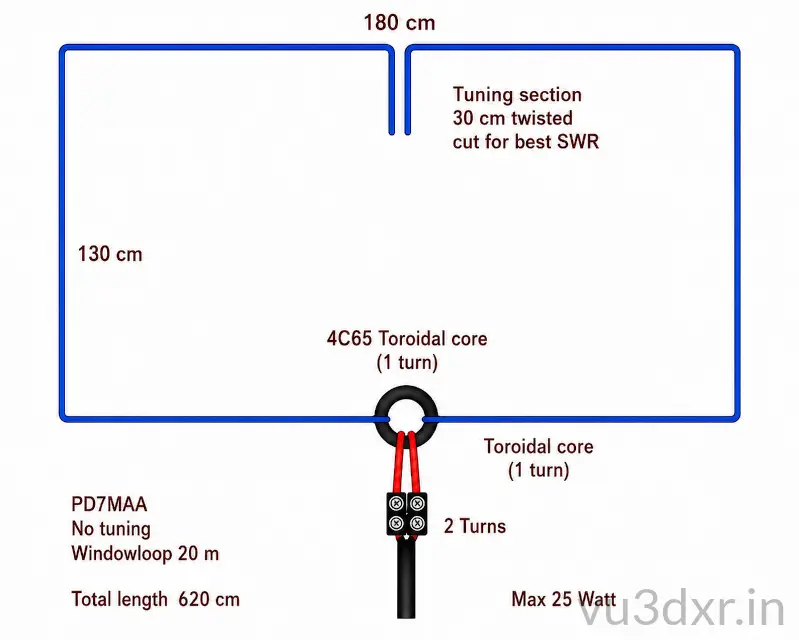
The Ultimate 20m Stealth Antenna: A Window Loop Guide

If you’re stuck in an apartment or a neighborhood with strict HOA rules, getting on the 20-meter band often feels like an uphill battle. You want to make contacts and participate in nets, but you can’t exactly mount a massive beam or a standing vertical on your roof without causing a stir. That’s where the PD7MAA Window Frame stealth Antenna comes in to save your hobby.

Ultimate 20m Stealth Antenna

The Ultimate 20m Stealth Antenna: A Window Loop Guide:

Compact Open Sleeve Dipole Antenna for 40 and 20 Meters

Finding enough space for HF antennas is becoming increasingly difficult. Small backyards, limited roof access, and portable operation often force radio amateurs to compromise between antenna size and performance.

This compactopen sleeve dipole antenna solves that problem rather elegantly.Radio

The open sleeve dipole antenna combines operation on both the 40 and 20 meter amateur bands while remaining considerably shorter than a conventional full-size dipole. Despite the reduced dimensions, performance remains surprisingly good, making it an attractive solution for portable stations, field operation, temporary installations, and restricted urban environments.

Open Sleeve Dipole Antenna for 40 and 20 Meters.

Compact Open Sleeve Dipole Antenna for 40 and 20 Meters

Wednesday, May 6, 2026

Build a 3-Element Directional Slim Jim Antenna for 2-Meters

Build a 3-Element Directional Slim Jim Antenna for 2-Meters: Learn how to build a directional Slim Jim antenna for amateur radio use. Includes measurements, design overview, performance benefits, and practical setup tips. 

End‑Fed & Long‑Wire HF Antennas


Terminated End Fed Vee Antenna (TEFV)
The TEFV is a terminated end‑fed Vee antenna intended for broadband HF coverage with minimal retuning. By accepting some efficiency loss in exchange for wide bandwidth and a quieter noise floor, it becomes a strong choice for multi‑band HF monitoring and casual operating. The article covers geometry, termination values, matching network and practical test results.

Multiband Half Wave End Fed Antenna
This multiband EFHW antenna uses a 1:49 transformer and carefully chosen wire length to cover several HF bands from a single feed point. It targets small‑plot or portable QRP operators who want 80 through 10 metre coverage with minimal hardware. Construction details, winding instructions and on‑air performance observations are provided for easy replication.

Building End Fed Half Wave Antenna (EFHW) for 40M – 10M
A practical EFHW focused on 40 to 10 metres gives solid multiband capabilities with a simple transformer and single wire. This project walks through transformer design, wire‑length tables, support options and tuning in real‑world conditions. It is aimed at portable, balcony and field operators who need quick deployment and predictable tuner behaviour.

Tree Mounted Quarter-Wave Vertical Antenna
The tree‑mounted quarter‑wave vertical shows how to hide an efficient HF radiator in plain sight by strapping it to an existing tree. Radials or counterpoise wires complete the system, giving low‑angle radiation for DX while remaining visually stealthy. The article explains mechanical fastening, wire routing, matching and on‑air performance from a typical suburban lot.

Antenna – Folded Beverage Antenna for HF Bands
This folded Beverage antenna is a receive‑only design built for serious HF DX listening with excellent noise rejection. It uses a long, low wire with specific folding and termination to achieve directional gain at low angles. The guide explains impedance, matching a 450‑ohm line to coax, termination design and how to protect the load from accidental RF power.

Rockloop & Loop‑Style HF Antennas


Antenna – Rockloop HF Antenna for 10,15,20 metre ham bands
The Rockloop is a compact multi‑turn HF loop aimed at 10, 15 and 20 metres, built from readily available tubing and a variable capacitor. It offers good efficiency from very small spaces with strong rejection of local noise, making it ideal for urban operators. The article walks through dimensions, mounting options and tuning methods so you can replicate the results.

Antenna – Foldaway Loop Antenna
This foldaway loop is designed for hams who travel or operate portable but still want serious HF capability. The loop collapses flat for storage yet can be deployed quickly in hotel rooms, balconies or rentals. The build covers mechanical hinges, conductor layout and tuning, showing how to achieve multiband coverage while keeping the antenna visually discreet.

Terminated Mini Loop Antenna: Small Space Ham Radio Antenna
The terminated mini loop trades raw efficiency for broadband coverage and low noise in very restricted spaces. Using a resistive load and compact loop, it covers a wide swath of HF without retuning, which suits SDR monitoring and casual HF listening in noisy apartments. The article details component choices, impedance matching and measured performance.

Loaded Loop Antenna – A Practical Balcony HF Solution
This loaded loop wraps an HF radiator around a balcony perimeter, using inductive loading to fit several bands into a compact rectangle. It’s aimed at operators with strict space or visual constraints, but who still want voice and digital contacts. The build shows mechanical mounting tricks, loading‑coil design and SWR results achieved from a real apartment installation.

HF Delta Loop Antenna
The HF delta loop is a full‑wave wire loop arranged in a triangular shape for improved low‑angle radiation and reduced noise pickup. It can be fed for different polarizations and offers a noticeable improvement over simple dipoles for DX work. The article explains dimensions, feed‑point options, matching techniques and real on‑air comparison results.

Aperiodic Multiband Wire Antenna: A Simple and Effective Design
This aperiodic multiband antenna is a non‑resonant HF wire using resistive termination and a broadband transformer for wideband coverage. It is ideal for SDR spectrum monitoring, utility listening and multi‑service monitoring where convenience trumps efficiency. The write‑up explains design theory, construction, measured return loss and when this approach beats traditional resonant wires.

Shortened & Compact HF Dipoles

Shortened & Compact HF Dipoles

Do it Yourself 80M Trapped Dipole Antenna
The 80 m trapped dipole provides 80‑metre coverage plus additional HF bands without needing full‑size wire lengths. By inserting resonant traps, the overall span shrinks while still presenting a reasonable match to common rigs. The article covers trap construction, wire cutting, support height and measured SWR data, making it accessible even for first‑time builders.

Short Linear Loaded Ham Radio Band HF Antenna
This short linear‑loaded antenna uses closely spaced conductors to emulate a longer HF element in a much shorter overall length. It is aimed at city hams who cannot fit full‑size dipoles yet still want acceptable efficiency and bandwidth. The project discusses layout, loading pattern, tuning with simple tools and expected performance compared to standard wires.

GM4JMU Shortened Dipole Antenna: Compact Performance for HF Bands
The GM4JMU shortened dipole is a proven compact HF design that cuts overall span while retaining respectable radiation efficiency. This build recreates the original concept with practical dimensions, construction photos and tuning hints from real deployments. It is well suited for rooftops, short gardens and portable masts where every metre of span counts.

Compact 40M HF Antennas: Short Dipoles & Short Verticals
Rather than focusing on a single design, this article compares several compact 40 metre antennas, including shortened dipoles and base‑loaded verticals. It shares NEC simulations, SWR plots and on‑air observations from a congested urban environment. This lets you choose a 40 m solution that best fits your available height, width and desired operating style.

Shortened Inverted V Antenna for 80 Meters (3.700 MHz)
To bring 80 metres into small plots, this antenna uses a shortened inverted‑V with loading coils placed along each leg. The design targets regional NVIS coverage for nets and emergency work. The article covers coil construction, wire layout, support requirements and tuning, with an emphasis on reproducible SWR curves and practical signal reports.

How to Build a Reduced Size 40M Antenna – Complete DIY Guide
This guide presents a systematic process for designing and building reduced‑size 40 m antennas, including loading, wire routing and matching. It combines modelling, empirical measurements and practical field tests to show the trade‑offs involved. The step‑by‑step instructions help you converge on a design that fits your site while still delivering useful DX performance.

Morgain Antenna: Dual-Band Dipole that Beats Traps
The Morgain antenna is a dual‑band HF dipole that uses folded wire sections instead of lossy traps to cover two bands. This project focuses on layout, element folding and feed details so you can realize its efficiency advantages. Real measurements and comparisons against conventional trapped dipoles are included to demonstrate gains in practice.

Multi Band Capacitor Loaded Shortened Dipole Antenna
Capacitor loading allows this multiband dipole to shrink physical length while still resonating on several HF bands. The article walks through capacitor selection, mounting methods, wire segmentation and typical SWR curves. It is intended for operators who can host a centre‑fed wire but not the full textbook length, especially in dense neighbourhoods.

Build Your Own Multiband G5RV Antenna: A Classic Ham Radio Project
This build revisits the classic G5RV multiband HF antenna with a focus on easily obtainable materials in India. It explains exact dimensions, ladder‑line section, feed transition and recommended tuner configurations. The project also shares practical tips for installation over real‑world terrain and notes on performance on bands from 80 through 10 metres.

20–40–80 Meter Loaded Multiband HF Dipole Antenna
This loaded multiband dipole provides coverage on 20, 40 and 80 metres using strategically placed coils and wire sections. It is designed for situations where only one HF wire can be installed but multiple bands are desired. Detailed dimensions, loading‑coil data, SWR plots and operating experiences help you reproduce the antenna with confidence.

Build a Doublet Dipole Antenna for 80m to 15m Bands
The 80–15 m doublet uses a balanced line and 4:1 balun to act as a flexible multiband radiator across several HF bands. It avoids the losses of many coax‑fed multiband solutions, while keeping construction straightforward. The article provides dimension tables, feedline guidance and tuner advice so you can adapt the design to your own mast height.

The Half Square Antenna: Low-Profile DX Wire for HF Bands
This half‑square antenna forms a π‑shaped wire with two vertical sections and one horizontal top, yielding low‑angle DX gain without radials. It feeds directly with 50‑ohm coax and often beats an inverted‑V toward the horizon. The project explains dimensions, support strategies, matching behaviour and offers measured comparisons to more familiar antennas.

Shortened EFHW Antenna for 80m to 10m

Shortened EFHW Antenna for 80m to 10m: Learn how to build a shortened EFHW antenna for 80m to 10m using a 49:1 transformer, 110µH loading coil, and RF choke. Includes antenna dimensions, tuning tips, SWR performance, and compact installation ideas for amateur radio operators.

Tuesday, May 5, 2026

Understanding the VHF Slingshot Antenna: A Smart VHF Solution

Understanding the VHF Slingshot Antenna: A Smart VHF Solution: A detailed guide to the VHF slingshot antenna, including dimensions, design principles, and performance benefits. Learn how this compact antenna improves signal strength and efficiency